
Optimizing Sample Locations#
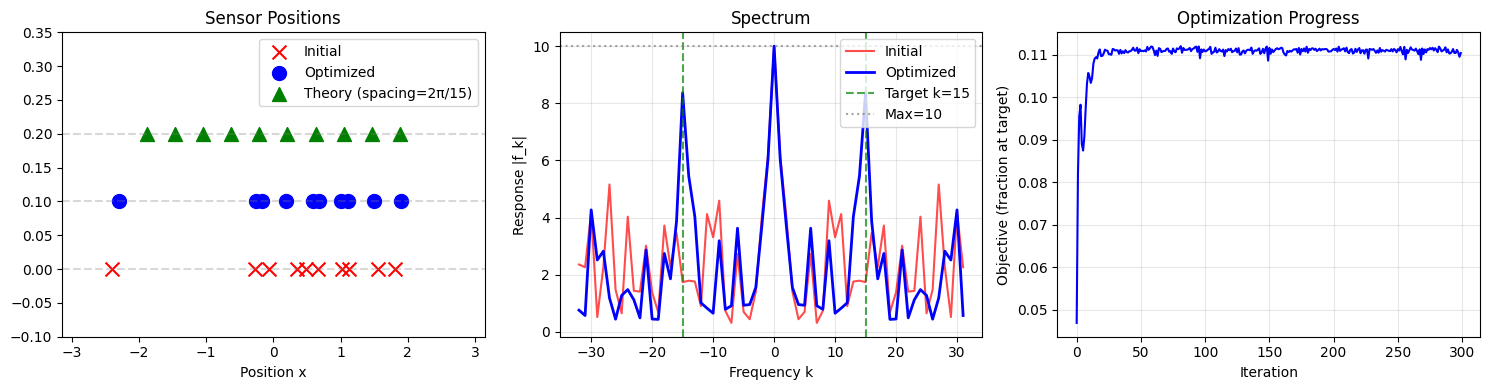
Problem: Place sensors to maximize response at a target frequency.
Because nufftax is differentiable w.r.t. positions, we can use gradient-based optimization to learn optimal sensor placement.
Setup#
First, install nufftax if running on Colab:
# Uncomment the following lines to install nufftax on Colab
# !pip install uv
# !uv pip install nufftax --system
import jax
import jax.numpy as jnp
import matplotlib.pyplot as plt
import numpy as np

from nufftax import nufft1d1
Mathematical Background#
The NUFFT response at frequency \(k\) is:
\[f_k = \sum_{j=1}^{n} e^{i k x_j}\]
For constructive interference at frequency \(k\), sensors should be spaced at \(2\pi/k\).
Key insight: The theoretical maximum response is \(n\) (all sensors in phase). We can learn this optimal spacing via gradient descent.
Define Optimization Objective#
n_sensors = 10
n_modes = 64
target_freq = 15  # Target frequency index

c = jnp.ones(n_sensors, dtype=jnp.complex64)


def get_spectrum(x):
    return jnp.abs(nufft1d1(x, c, n_modes=n_modes, eps=1e-6))


def objective(x):
    """Maximize fraction of energy at target frequency."""
    spectrum = get_spectrum(x)
    idx_pos = n_modes // 2 + target_freq
    idx_neg = n_modes // 2 - target_freq
    target_power = spectrum[idx_pos] + spectrum[idx_neg]
    return target_power / (jnp.sum(spectrum) + 1e-6)
Run Optimization#
# Initial random positions
key = jax.random.PRNGKey(42)
x_init = jax.random.uniform(key, (n_sensors,), minval=-jnp.pi * 0.9, maxval=jnp.pi * 0.9)
x = x_init.copy()

# Store initial spectrum
spectrum_init = get_spectrum(x_init)
print(f"Initial response at k={target_freq}: {spectrum_init[n_modes // 2 + target_freq]:.2f}")

# Optimize with momentum
grad_fn = jax.grad(objective)
velocity = jnp.zeros_like(x)
lr, momentum = 0.1, 0.8

history = []
for step in range(300):
    velocity = momentum * velocity + lr * grad_fn(x)
    x = x + velocity
    x = jnp.clip(x, -jnp.pi * 0.95, jnp.pi * 0.95)
    history.append(float(objective(x)))

# Final spectrum
spectrum_final = get_spectrum(x)
print(f"Optimized response at k={target_freq}: {spectrum_final[n_modes // 2 + target_freq]:.2f}")
print(f"Theoretical maximum: {n_sensors}")
Initial response at k=15: 1.74
Optimized response at k=15: 8.37
Theoretical maximum: 10
Compare with Theoretical Optimal#
# Theoretical optimal: spacing = 2*pi/k
spacing = 2 * jnp.pi / target_freq
x_theory = jnp.arange(n_sensors) * spacing - (n_sensors - 1) / 2 * spacing

spectrum_theory = get_spectrum(x_theory)

print("\nComparison:")
print(f"  Initial response:     {spectrum_init[n_modes // 2 + target_freq]:.2f}")
print(f"  Optimized response:   {spectrum_final[n_modes // 2 + target_freq]:.2f}")
print(f"  Theoretical response: {spectrum_theory[n_modes // 2 + target_freq]:.2f}")
print(f"  Maximum possible:     {n_sensors}")
Comparison:
  Initial response:     1.74
  Optimized response:   8.37
  Theoretical response: 10.00
  Maximum possible:     10
Visualization#